

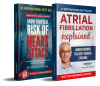
Atrial Fibrillation Explained and Know Your Real Risk of Heart Attack (Special Bundle) Colour Hardcover Editions
"Know Your Real Risk of Heart Attack" This Book Could Save Your Life
A number of years ago something incredible, an amazing coincidence, happened that started Doctor Warrick Bishop on the mission to prevent heart attacks rather than try to cure them...
What Is This Book About?
As a cardiologist, I have not yet met a patient who expected to have a problem; patients do not put into their diaries “possible problem with my heart next week”. Yet, what if we could be forewarned about, or prepared for, a potential problem with our coronary arteries? … What if we could plan NOT to have a heart attack?
Know Your Real Risk of Heart Attack is the first-of-its-kind, offering a balanced and referenced discussion of coronary risk assessment using modern technology.
This book will empower you as an individual to choose how you want to deal with your risk of the single biggest killer in the western world.
Atrial Fibrillation Explained is a must-read for sufferers and those who care about them, medical practitioners and anyone planning to live into a healthy, old age. Having a better understanding of AF as a disease and learning about its treatment will open up meaningful conversations between patients and their medical practitioners, leading to greater insight into the best way to look after the condition in personal sets of circumstances.
This book is a must-read for you.
This book is for you, if you:
- have atrial fibrillation or know someone who does
- want to understand the condition
- are a doctor wanting a straight-forward refresher or a book you can recommend to your patients
- need to know that you are not alone
- want to know what’s going on with your heart
- come from a family with ‘bad’ hearts
- would enjoy an informative read about a very common condition
- believe that understanding assists with better management
Reviewed on 17th Oct 2026
Calcium scores and what to do with a high value
[I am not medical doctor. I have no medical training. However, I have 7 cardiac stents so my interest in Coronary Heart Disease is not purely academic.]
Once upon a time there was homocysteine, a sulfur-based amino acid. According to WebMD, "You get it mostly from eating meat. High levels of it are linked to early development of heart disease." The question, then, was to determine whether homosysteine was a like a car's accelerator or its speedometer, that is, was lowering homocysteine like taking one's foot of the brake, or was it like trying to stop a car by grabbing onto the speedometer? Again, from WebMD, "Research has shown, however, that getting your homocysteine levels down with vitamins doesn’t reduce your chance of having heart disease." Oh, well,...
Then, there was C-reactive protein, a measure of inflammation. It was thought to be a mediator of Coronary Heart Disease and the next big thing in assessing cardiac risk. And then...nothing. It felt like CRP went from being assessed on almost everyone thought to be at risk to almost no one. Maybe it's because so many things other than heart disease can lead to high levels.
Now, we have calcium score. The higher the calcium score, the greater the risk of a serious coronary event. But what is one to make of a high calcium score? I know someone with a score of 300 who was told not to do any exercise until he was given a stress test, which he passed. (And, yes, there are may tales of those who have suffered serious events after having passed a recent stress test.) Is a calcium score a real advance or is it merely the latest in a string of false leads?
The calcium score itself is not controversial. The question is what to do with it other than a stress test or a statin if the score is high. And might it turn out to be another homosysteine or CRP?
The value of Dr, Bishop's book is its suggestion of a next step after a high calcium score--a scan with contrast to determine the location of the deposits are that are behind the high score. He provides evidence to support his recommendation. I found it compelling enough to start a conversation with my cardiologist if I had a high score, myself. (This is not an option for anyone with stents because the stents would interfere with the scans.)
Those concerned with their risk of having a coronary event, perhaps due to family history, should read this book to prepare for an intelligent conversation with their own cardiologists.
Other comments:
Others have commented on the book's use of mmol/l instead of the mg/dl used in the US. It can be confusing. However,
(Bishop) mmol/l *38.7 = mg/dl (US)
Ratios are unaffected by the choice of units.
Try to avoid the audio version alone. I like audio books, but the information and message do not lend themselves well to an audiobook.
[Disclaimer: I was given a copy of the book in exchange for my honest review. Review copies of books are permitted by Amazon. I have no problem with my review. However, I've spent too much time agonizing over how many stars to award.
5 stars: I have seen first person someone with a high calcium score who was not offered the followup suggested by Dr. Bishop. The book is well worth the price if it prevents or postpones a serious coronary event, especially if it's yours. The information is presented in a way that anyone reading the book could have an intelligent conversation with his/her cardiologist about calcium scores and what should be done with them.
4 stars: A bit pricey, although much less expensive than having an MI. The choice of mm/l with no instructions for conversion to mg/dl was a huge distraction. A fear that I might be influenced to go higher (5 instead of 4) for having received a free copy. Note: fear of unconscious bias applies to the number of stars, not to the review itself.
When I started writing this disclaimer, I knew I'd award 4 stars because "If you have to think about it..." However, after reading what I've written about my quandry...]
Reviewed on 17th Oct 2026
An easy to understand proactive approach to prevent cardio problems
This book is a must for anyone who has a history of cardio problems in their family or are experiencing problems of their own. In fact, if you aren't sure, you need to read this book anyway. I learned more about my heart, various tests and results than I would ever have imagined in this short and concise book. I am not a doctor and all the details and test results seem to blur for me. In this book Dr. Warrick provides cases and outlines test results compared to what would be ideal. I can now use this book as a guide when I review my results. More importantly though is that Dr. Warrick lays out a path to using CT scans to proactively prevent heart attacks rather than just treating the disease after you have one. Ironically, after I started reading this book, I developed a (non-heart) medical issue based on traditional medical test results in which a CT scan was used to further determine whether there was an actual issue. If works for one part of the body, why not for cardio as well? This is a great read presented in a very easy to understand format. I am grateful for having had the opportunity to read this book. It is a great reference book to have on hand.
Reviewed on 17th Oct 2026
Prevention Is Better Than Cure - Easy Read
The book is clear, concise, and lays out a plan to be proactive in preventing a heart attack. It was quite easy to follow and understand. This comprehensive book will not only serve as a wake-up call for many but also save lives. I now have an interest in a CCTI where I didn't before.
The book explains the functions of the heart and how plaque is formed in the arteries and then how to detect and treat it. His primary focus, of course, is on prevention of heart disease and how you can accomplish that.
I feel much more comfortable talking to my doctor about this subject. I am much more prepared to hold an honest and informative discussion.
I also think that he didn't write to his potential reader base. Americans will not comprehend most of the notations for the lipid panel values. Might have noted American notations as well. He lost me there throughout.
Disclaimer: I was offered this book in exchange for my honest opinion of it.
Reviewed on 17th Oct 2026
Boy, did you bite off more than you can chew!
It is a really remarkable achievement to prevent a heart attack long before you even get the symptoms of the heart attack. In this book we have indicators that you can use to do just that! It is a very difficult thing to not have any pain or problem of which you know, but that you may have a problem a few years down the road. This book begins to explain how you may do just that. It is a primer but the explanations are concise and with a bit of humor as well. Get the book...it will give you some things to think about.
Reviewed on 17th Oct 2026
Despite known risk factors or lack of known risk factors....
I think this book is good for anyone with a question about whether they have a true risk of heart attack or to understand the functionality of the heart and arteries. However, to be clear, it doesn't actually teach you what your real risk is. It tells you how you can find out your real risk. It explains what the heart does, explains that risk factors such as cholesterol, blood pressure, weight/BMI, etc are not always indicative of the real risk, etc. It's a good book to learn about the true risk, and how each person is an individual. According to the book, the only way to know the true risk is to have the CT scan to evaluate the arteries. That's how you know your real risk. It makes sense.
Most doctors base risk on family history, lifestyles, and "numbers" (such as blood pressure, cholesterol, weight/BMI, etc). I have a strong family history. I have good "numbers" and a good lifestyle...so according to the doctors, I'm okay. My risk should be low. But, to assess my true risk, according to this book, I would have a CT scan to evaluate what's really going on in my arteries. I believe that would be a true indicator and could give me reassurance, or it could cause me to take steps to prevent the heart attack. Unfortunately, that CT is not covered and it's expensive here in the US---and you need a doctor who will agree to order the test and then you need to be able to pay out of pocket for it.
Overall, good information, and this could potentially have the ability to save someone from a heart attack.
Unfortunately, it's not a viable option for everyone to have that test to know their true risk.
Reviewed on 17th Oct 2026
GOOD READ
Reviewed on 17th Oct 2026
Best Non-fiction Book That I Have Read?
Reviewed on 17th Oct 2026
A clear and concise explanation that is really helpful to non-medical people, without being condescendingly over-simple
Reviewed on 17th Oct 2026
Good resource if you have AF
Reviewed on 17th Oct 2026
Great explanation of AF and it's treatment